
Jasmin (She/her)
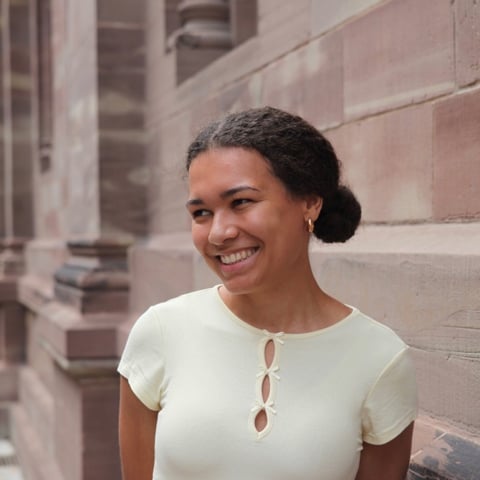
I‘m a psychology student with a passion for politics and democracy. I love broadening my horizons and having conversations that make me see the world from a different perspective.
“
Your voice matters. Your actions make it real. - Emma Watson
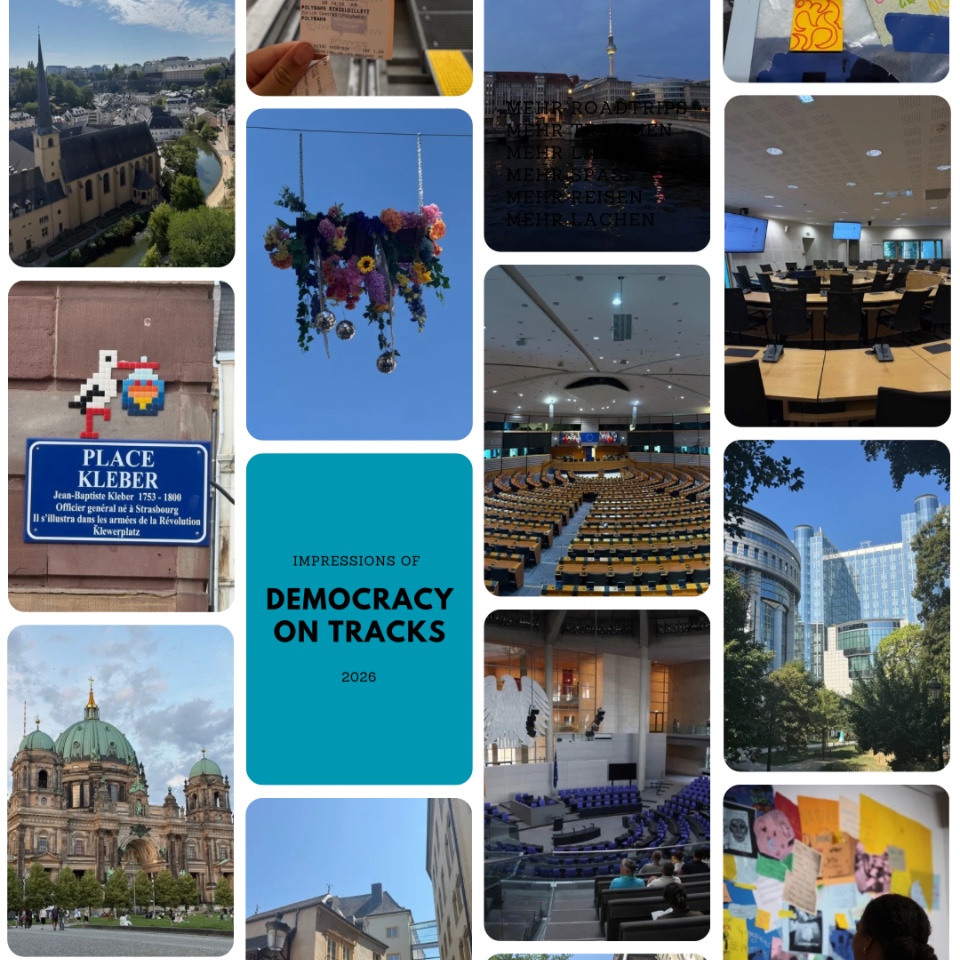
It was an incredible experience that gave me the opportunity to learn more about Europe and its diverse cultures. During the trip, I gained new perspectives, learned a lot about other European countries and was able to create wonderful new experiences that I will cherish forever. 🌸
Field notes from the DOTS route
Six pieces Jasmin wrote and collected along the way — Berlin, Brussels, Luxembourg, Strasbourg, and a free-day detour to Zurich. Click any title to read it in full.
Experiencing democracy in Brussels
"What does it feel like to stand in a place that represents democracy?" This question came to my mind before our visit to the European Parliament in Brussels. From the outside, the building appears modern and impressive. Behind its walls, representatives from across Europe come together to discuss issues that shape the lives of millions of people. One of the most fascinating parts of the visit was the hemicycle, where members of the European Parliament gather for debates and votes. Looking down into the hemicycle, where important decisions about Europe are made, I gained a deeper understanding of how political decisions can shape the lives of millions of people. Standing in this room made democracy feel more real, personal, and tangible. Moreover, the European Parliament also represents the diversity of the European Union, which can be seen in the different flags representing the EU member states and the many languages used throughout the Parliament. On the one hand, this diversity can create challenging debates, but it also demonstrates one of the central principles of democracy, such as how different opinions can meet and lead to common decisions. Another aspect that stood out to me was the responsibility connected to democratic decision-making. Every debate and every vote can influence the future of millions of people. This makes political participation especially meaningful because it indicates that democracy depends on people who are willing to listen to different perspectives and take responsibility for the society they live in. Visiting the European Parliament therefore felt like experiencing democracy from a completely different perspective. For me, it transformed an abstract political concept into something more visible. As I left the building, I therefore thought that democracy gains its true meaning when people participate in it and shape its future together.
View the original (jasmin-experiencing-democracy-in-brussels.pdf)Experiencing democracy in Berlin
It is often perceived that there is no difference between the Bundestag and the Reichstag. However, the Reichstag is the building, while the Bundestag is the parliament inside it. When standing in front of the Reichstag, this difference becomes more clear. Behind its walls is Germany's political center, but also a place that carries a lot of history and shows how important democracy really is. The first thing that catches the eye inside is the famous glass dome. Due to its architecture, sunlight fills the entire room and visitors can look down into the parliament hall below. It is an astonishing design, although its meaning is even more striking because it shows that political power should never be hidden from people. They ought to be able to see where decisions are being made and how the decision-making process works. Likewise, the eagle, which is a symbol of the German state, stands above the people who are responsible for making political decisions. Thus, it is impossible to ignore it and it almost feels as if it is watching over the room. On the other hand, the eagle also carries a warning. The Reichstag has witnessed a Germany that once had a democracy (1919-1933) and then lost it. The Nazi dictatorship showed how quickly freedom can disappear when democratic values are destroyed. Then war followed, after it Germany was divided and the Reichstag became a symbol of this broken country. Only decades later (after reunification) did the building become the home of the Bundestag again. These historical facts make a visit to the Reichstag very special because the building tells a crucial part of Germany's story. It illustrates what can happen when democracy is lost and how difficult, but also how important, it is to rebuild it. Therefore, the eagle is a national symbol that can be seen as a reminder that democracy may look strong with its elections and laws, but it is never guaranteed and should never be taken for granted! It needs people who accept different opinions and speak up when democratic values are threatened. Under the glass dome, with the eagle watching from above, history and the present seem to meet in one moment, which is why I left with a certain message in mind. Democracy is something we have to protect and value every single day!
View the original (jasmin-experiencing-democracy-in-berlin.pdf)Where the ground remembers
A place that carries thousands of suppressed voices under the quiet blue sky. Where the ground keeps a dark memory, like a shadow without a body. We walk slowly where voices once became orders and names became numbers, a place where fear lived behind closed doors. The city still moves around it. Crowded busses, people are chattering, breathing life into Berlin. But here, time feels different and we are back in the Third Reich. They heard the trains before they saw the toxic smoke. Close neighbours disappeared, doors left empty, names got removed from streets like they never existed. Erased from their homes. How much did they know? Maybe not every detail, probably not every name. But enough to feel that something was wrong. Some looked away. Some were afraid. The truth was lying everywhere in small hints like the broken window next door or a missing friend. When I look down, I only see grey stone, but beneath my eyes, history is still moving. It's like a cold wind that touches underneath my skin and disappears before I can catch it. It whistles that the past still walks beside us. And just like that the question shifts from "How much did they know?" to "How much did they choose not to know?" However, the empty space in the museum leaves the question up to you. It tells you: Remember now! And this time it is us who have to take action, before it is too late…
View the original (jasmin-where-the-ground-remembers.pdf)A place where every colour belongs
In Luxembourg, we entered a space where every story has its place. A queer organization, warm and bright, filled with unique voices and powerful colours. Love is love, in every form like a fire that never stops burning. Different hearts and various ways can bring their colors to our days. We listened to our stories and experiences, created by the harsh reality. Imagine a world without judgement, where kindness opens every door, where people feel at home inside the selves they have been searching for. Be your beautiful self, with pride, let your colors walk beside you and let your voice become a part of something bigger to create change. From Luxembourg, the message grows. Every heart deserves a place to shine. Through curious minds and open hearts, our different worlds can intertwine. We came to experience how love can build community. And when we left, one thought remained. A brighter world begins with change!
View the original (jasmin-a-place-where-every-colour-belongs.pdf)Experiencing democracy in Strasbourg
When we think about Europe, we often think about the European Union, the euro, open borders, political cooperation and many other things. However, there is another European institution that plays an important role in protecting our rights, the Council of Europe. The Council of Europe was founded in 1949, only a few years after the end of the Second World War. Back then, ten European countries came together with a shared goal, to build a Europe based on human rights, democracy and the rule of law with the message, "Never again." Today, the Council of Europe has 46 member states and represents around 700 million people. Its work is based on the idea that human rights should be protected in everyday life. One of its most crucial achievements is the European Convention on Human Rights, which protects fundamental rights such as freedom of expression and the right to a fair trial. Likewise, the European Court of Human Rights gives individuals the opportunity to take action when they believe their rights have been violated. What I find particularly interesting is the connection between human rights, democracy and the rule of law. These three principles create a stable foundation for the involved democratic societies and indicate that democracy goes beyond elections. Another thing that stood out to me during the visit was the focus on young people. The Council of Europe actively tries to involve young people in democratic life and gives them opportunities to share their ideas and take part in decision-making. Seeing this made the idea of democracy feel more relevant to me because young people are also part of the society they want to shape. Moreover, the visit also made me realise how relevant the Council of Europe remains today. Europe faces new challenges, from war and discrimination to threats to freedom of expression and the impact of artificial intelligence. The organisation continues to address these issues while protecting its core values. For instance, the situation in Ukraine shows the importance of the Council of Europe today. After Russia's invasion of Ukraine, Russia was excluded from the organisation in 2022. Since then, supporting Ukraine has become a vital part of the Council of Europe's work, especially in areas such as justice and accountability. Looking at the Council of Europe today, I think its original idea remains just as relevant as it was in 1949. Human rights and democracy require continuous protection and active participation.
View the original (jasmin-experiencing-democracy-in-strasbourg.pdf)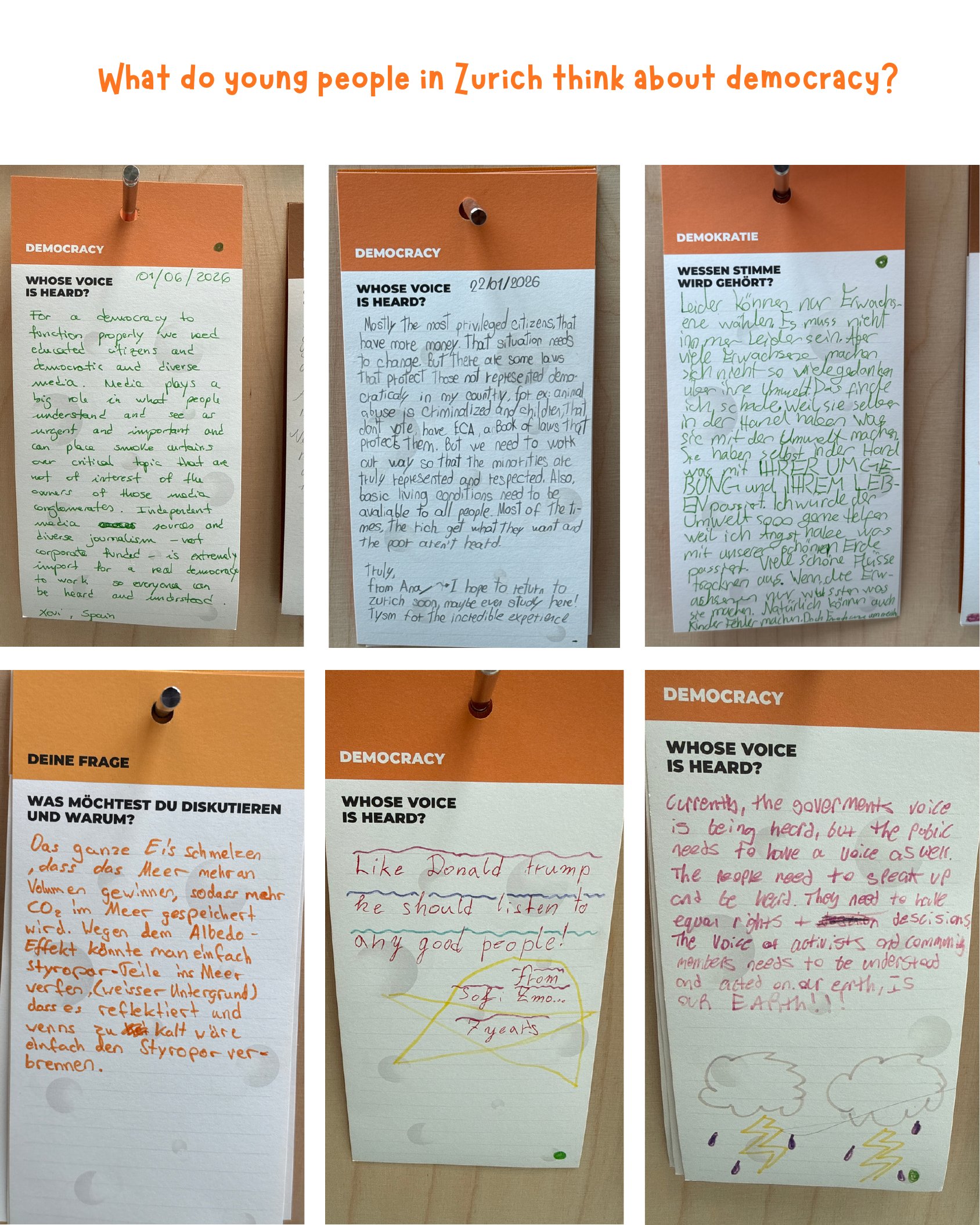
Zurich, free-day detour: a street-interview project asking "Whose voice is heard?" — the replies, photographed exactly as filled in.